When I was converting Good Work! into an ebook, I found three significant typos. Not buried in the copy—in a headline, another headline, and a pull quote graphic I designed myself (that one really hurt). Large type. Prominent placement. And at least five people, including me, had read the final manuscript multiple times and reviewed the designed book before I found them.
Extra words. Hiding in plain sight.
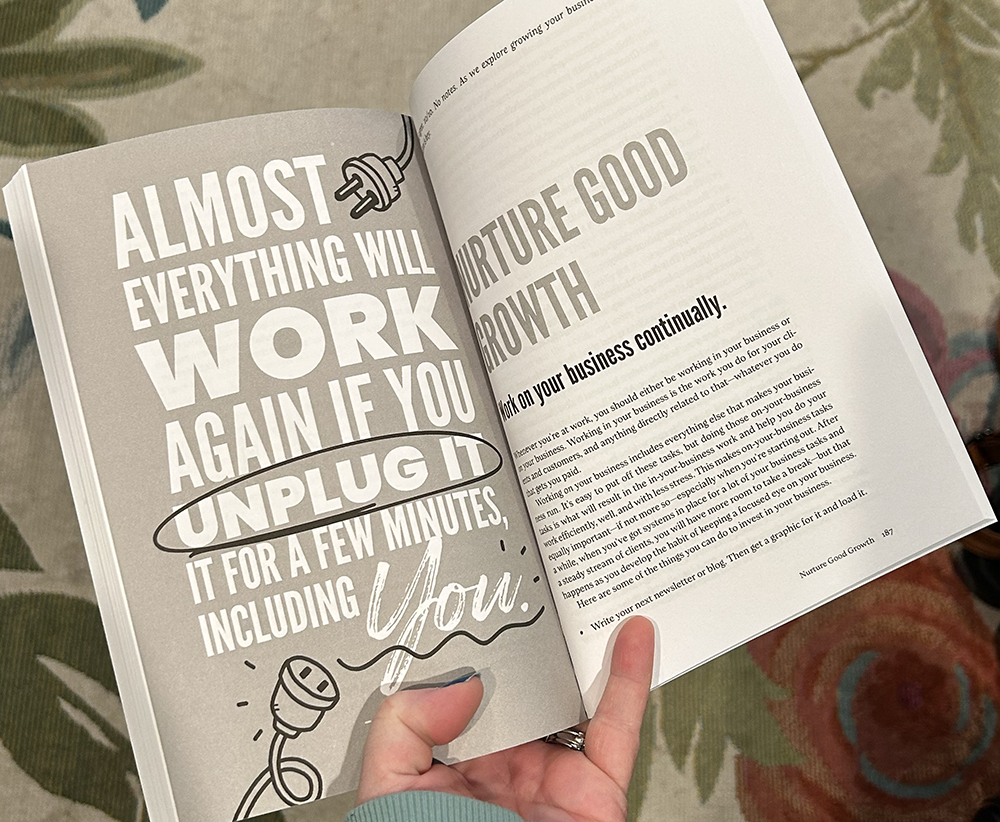
My first reaction was embarrassment. My second was something closer to fascination. How does that happen?
Your Brain Is Too Helpful
It turns out this isn’t a focus problem. It’s a cognition problem. When we read, we don’t process every letter or even every word. Our brains are pattern-matching machines. We take in the shape and context of a phrase and predict what it says based on what we expect it to say. In most cases, this is incredibly efficient—it’s how we can read quickly without consciously decoding every character.
But in proofreading, that efficiency works against you. If your brain already knows what a headline is supposed to say, it will “see” the correct version even when the words on the page say something different. The unexpected word—the extra “the,” the repeated “in”—gets smoothed right over.
The more familiar you are with something, the stronger this effect. Which is a strange kind of cruel joke when it comes to your own work: the person most invested in getting it right is also the person least capable of seeing certain kinds of errors.
Headlines and designed graphics are especially vulnerable. You’d think prominent, short text would be the easiest place to catch mistakes. But headlines get scanned for meaning, not read word by word. And once a design looks polished and finished, the brain shifts into evaluating mode (“does this look right?”) rather than reading mode (“does this say the right thing?”). The visual finish signals “done,” and everyone moves on.
This Is Exactly Why I Hired a Proofreader
In the book, I talk about the moment I finally stopped trying to proofread my own client work. I was doing a lot of social media graphics and moving fast, and I knew I wasn’t catching everything I should. So I hired a proofreader. It was game-changing for me.
And then I wrote a whole book, had three proofreaders and a book designer review it, read it myself a million times, had other readers go through it too, and I still found three typos when I changed the format.
The thing about getting help: it’s not a guarantee. It’s a significant improvement. There’s a difference between having five familiar people read something multiple times and having one cold reader encounter it for the first time. Both matter. They catch different things. And even together, they won’t catch everything—because the process of finishing something, of having something look done, works against the part of our brains that’s supposed to find what’s wrong.
Done Is Still Better Than Perfect
I also write in the book about not waiting for perfection—that nothing will ever be exactly right, and spending too long trying to make it so wastes time and energy you don’t have.
I still believe that. And finding three typos in my published book hasn’t changed it.
The typos are embarrassing. They’re also fixed now in the ebook and in the print versions. If I had waited until I was certain the manuscript was flawless, I’d still be waiting. The book existing in the world, imperfect, has been more useful to more people than a perfect book I never finished would have been.
What I took from this experience isn’t “do more rounds of review.” It’s that format changes matter — the ebook conversion is what shook the typos loose, because it forced my brain to process the text differently. Reading short, prominent text aloud word by word does the same thing. Separating “does this look right” from “does this say the right thing” as two distinct review passes is worth doing, especially for headlines and graphics.
And sometimes, even after all of that, something slips through. You own up to it, fix what you can, and keep going. That’s in the book too.
If any of this resonates — the tension between getting it right and getting it done, the challenge of seeing your own work clearly, the question of when to ask for help — there’s a lot more in Good Work! Pick up a copy at Amazon.com or Bookshop.org.